
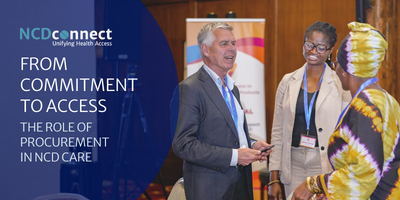
Reflections from the 2026 NCD Coalition Annual Meeting in Nairobi

There was no shortage of ambition at this year’s NCD Coalition Annual Meeting in Nairobi.
Across three days of discussions, government representatives, development partners, researchers, patient advocates, and private sector organizations shared encouraging examples of progress. Countries are expanding NCD services through primary healthcare, strengthening health financing systems, investing in digital health, and placing greater emphasis on prevention and early diagnosis.
Amid all the discussions about financing, policy, and innovation, access appeared as a key issue. More specifically, the question of how we ensure that people living with NCDs can reliably access the medicines and health products they need?
Whilst many countries are making significant progress in screening, diagnosis, and service delivery, access to treatment remains inconsistent. Stockouts, forecasting challenges, fragmented procurement practices, and gaps in supply chains continue to stand in the way of patient care.
The challenge is not only funding
A common assumption is that limited access to NCD medicines is primarily a financing problem.
Financing is certainly part of the picture. Many countries are working to better understand what they spend on NCDs and how those resources can be used more effectively. Yet several conversations during the meeting suggested that funding alone will not solve the problem.
In country after country, participants described similar challenges. Medicines are budgeted for but not always available. Demand is difficult to predict. Procurement processes are often designed around short-term purchasing cycles rather than the ongoing needs of people living with chronic conditions.
The result is a familiar scenario: patients are diagnosed, healthcare workers are trained, services are available, but treatment is not consistently within reach.
NCDs require a different way of thinking about procurement
One of the strongest messages from the meeting was that many health systems are still procuring for acute conditions while trying to manage chronic diseases.
NCDs do not behave like emergencies. They require continuous access to medicines over months, years, and often a lifetime. This requires a different approach to procurement.
Rather than reacting to stock shortages, countries increasingly need systems that can accurately forecast demand, aggregate purchasing requirements, and create a more predictable supply environment for both buyers and suppliers. This was reflected in discussions around Africa CDC’s African Pooled Procurement Mechanism (APPM), which is focused not only on procurement itself but also on market shaping, supply security, and making demand more visible across the continent.
It is a shift from asking, “How do we buy products?” to asking, “How do we build a system that ensures products are available when patients need them?”
Encouraging signs of progress
The good news is that countries are already moving in this direction.
Kenya shared examples of investments in digital health systems, improved visibility of health data, and efforts to strengthen local manufacturing. Ghana highlighted ongoing reforms linked to universal health coverage and primary healthcare. Somalia, Rwanda, and the DRC all spoke about integrating NCD services more deeply into national health strategies and health systems.
At a regional level, conversations around local manufacturing, regulatory harmonization, and pooled procurement suggest that countries are increasingly looking beyond individual programmes towards more sustainable, long-term solutions. What was particularly encouraging was the sense that NCD access is no longer being discussed solely as a healthcare issue. It is increasingly seen as a systems issue, one that requires collaboration between governments, suppliers, manufacturers, financiers, and implementation partners.
Turning conversations into access
One reason the NCD Coalition remains such an important platform is that it brings these different perspectives together in one room. As several participants noted, there are few spaces where public and private sector stakeholders can have practical conversations about what it takes to improve access to NCD care at scale.
The conversations in Nairobi were less about what needs to happen and more about how to make it happen. How to make financing work harder. How to strengthen forecasting. How to reduce stockouts. How to create procurement systems that support continuous care rather than intermittent treatment. These are not always the most visible parts of healthcare reform, but they are often the difference between policy commitments on paper and medicines on the shelf.
Looking ahead
As governments across Africa continue to strengthen their NCD responses, attention is increasingly shifting from awareness to implementation. The challenge now is not simply expanding services. It is ensuring that the products needed to support those services are consistently available, affordable, and accessible.
The discussions at this year’s NCD Coalition Annual Meeting made one thing clear: improving NCD outcomes is about more than introducing new policies or new programmes. It is about strengthening the systems that connect patients to care.
And increasingly, that conversation starts with procurement.
Want to learn more about how NCDconnect can support supply chain and procurement of NCD medicines and medical devices? Explore our solutions and partnership opportunities at NCDconnect.org