
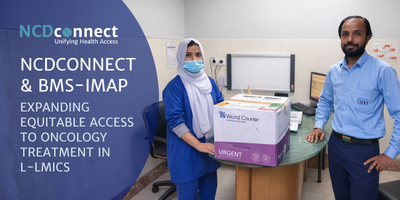
As a member of the UICC-led ATOM Coalition, NCDconnect has partnered with Bristol Myers Squibb (BMS) and Coalition partners to help implement BMS’ Innovative Medicines Access Program (IMAP). NCDconnect plays a critical role in this by designing country-specific access and public/private procurement pathways, coordinating the end-to-end supply chain, and ensuring that life-saving immuno-oncology therapies reach patients in need.

Photograph of Oncology pharmacist and logistics representative at National Medical Center, Pakistan
Access to innovative cancer therapies in many low- and lower-middle-income countries (L-LMICs) remains limited. This is not because these medicines don’t exist, but for several complex reasons, including: health system constraints; gaps in pathology and diagnostics; limited pre-paid and pooled health financing to limit out-of-pocket costs for patients; supply chain and regulatory challenges; and a lack of structured access pathways.
At NCDconnect, we fundamentally believe that every patient deserves access to the best standard of care and quality-assured medicines. Overcoming these barriers requires multi-stakeholder collaboration and collective action, strengthened clinical capacity, regulatory and public/private procurement pathways that support long-term access.
IMAP is one of the pillars supporting BMS’ long-standing commitment to promote health equity and help people in underserved communities access the care and medicines they need. Through IMAP, BMS’ life-saving medicines, including immuno-oncology medicines, are being introduced to institutions via compliant, scalable, and sustainable access pathways that align with national priorities and existing health infrastructure.
Enabling patient access: public & private sector implementation
UGANDA: At the Uganda Cancer Institute (Uganda’s largest public cancer hospital and national oncology referral center) patients can access cancer care free of charge. Through close collaboration with UCI, a new pathway has been established to expand equitable access to immuno-oncology treatments in the public sector. Multidisciplinary medical education on immuno-oncology drug use and patient safety conducted by BMS-Medical with TC4All has supported clinicians and pharmacists in safely administering and monitoring these therapies, while a publicly funded bulk procurement mechanism now enables sustainable access to nivolumab. Under this model, NCDconnect coordinates quarterly deliveries covering the institute’s annual treatment needs – helping ensure life-saving cancer innovations reach Ugandan patients through a reliable and financially sustainable system.
ZAMBIA: In Zambia, the Cancer Diseases Hospital (CDH) joined IMAP and began using immuno-oncology medicines alongside strengthened patient safety practices in late 2025. Backed by strong public leadership, this work is paving the way for broader system readiness across both public and private oncology sectors. Early work on a public-private partnership model signals promising routes toward long-term financial sustainability, facilitated by the ATOM Coalition.
NIGERIA: In 2025, NCDconnect successfully delivered nivolumab to Lakeshore Cancer Center (LCC) in Nigeria, establishing a supply pathway. This ensures continuity of care and timely access to advanced treatment options. Efforts are underway to introduce IMAP at a publicly funded hospital network system established to provide world class, accessible, and affordable healthcare services across Nigeria.
PAKISTAN: In the first quarter of 2026, NCDconnect worked with private institutions to procure nivolumab & ipilimumab, delivering critical therapy to patients in need and reinforcing the growing commitment to improving oncology outcomes across the country. With local partners, the objective is to scale access to innovative cancer medicines to patients in over 20 treatment centers over the next year.
Alongside the above activities, efforts are underway to expand IMAP to public, faith-based and additional private oncology settings across Kenya, Uganda, Nigeria, Ethiopia, Tanzania, Rwanda, Senegal and Côte d’Ivoire. By working with providers and regulators in these markets, NCDconnect and partners ensure transparent, regulated access aligned with local frameworks that enable continuity of care for patients.
Looking forwards
Last year, IMAP was implemented across ten low and lower-middle income countries (L-LMICs). Throughout 2026, this work will continue with deeper implementation in existing markets and expansion to additional eligible L-LMICs. Priority activities will include earlier importation pathway mapping, expansion to new public, faith-based, and private facilities, and ensuring continuous supply to already engaged institutions.
Why equitable access to quality-assured immuno-oncology matters
Expanding equitable access to immuno-oncology treatment requires more than the availability of innovative medicines alone. While these therapies have the potential to transform cancer outcomes, access remains highly unequal across regions due to gaps in regulatory frameworks, clinical capacity, and overall health system readiness.
Because immune-oncology medicines are high-value, they carry a greater risk of counterfeit or substandard products entering the market. Through our partnership with Bristol Myers Squibb, we can ensure a reliable supply of quality-assured treatments at not-for-profit prices.
Addressing these challenges cannot be done without sustained multi-stakeholder collaboration, technical expertise, and long-term commitment. By bringing together partners across clinical, regulatory, supply chain, and policy domains, we help demonstrate how coordinated, system-focused efforts can enable the responsible use of innovation and contribute to stronger, more resilient oncology care across Africa – one health system, one institution, and one patient at a time.
Want to learn more about how NCDconnect supports equitable access to cancer treatments? Explore our solutions and partnership opportunities at NCDconnect.org